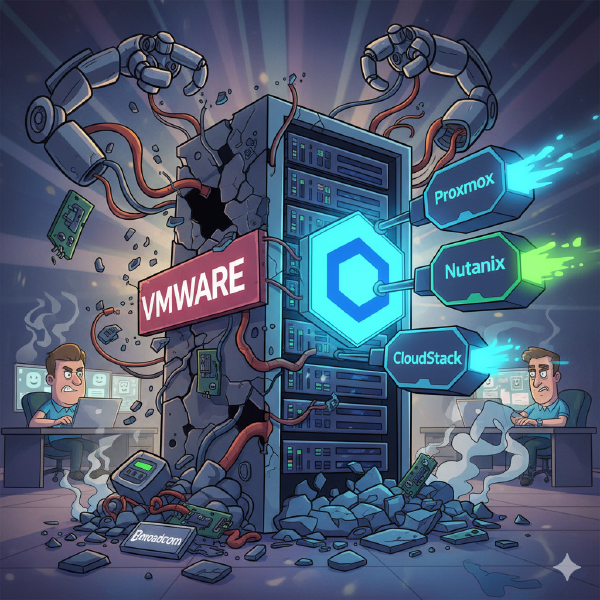

The virtualisation landscape has shifted this year, and the shift is not subtle. Ask any infrastructure team that has renewed a VMware contract since the Broadcom acquisition and you will get a strong opinion. More often than not, that renewal is the reason a VMware migration project ends up on next year’s roadmap. The Broadcom licensing changes did not just annoy people. They changed the question worth asking, which is not whether the market is moving toward VMware alternatives. It clearly is. The question is whether Proxmox actually deserves the crown it is being handed on LinkedIn, or whether the story is getting ahead of the product.
The fall of ESXi is real, not manufactured#
The per-core subscription model that followed the Broadcom acquisition pushed licensing costs up sharply for a large share of mid-market environments. Reported increases range from steep to absurd depending on the environment. This is not a fringe complaint. It is the single biggest driver behind the current migration wave.
ESXi remains excellent technology. Large enterprises deeply embedded in the VMware ecosystem, with vSphere-dependent tooling and years of institutional knowledge, still have a defensible case for staying put. But for SMB and mid-market shops, the return on investment has quietly disappeared for a lot of people, and that is not a marketing narrative. It is a spreadsheet. I wrote about the trust side of this collapse in more detail in VMware Is Dead: Broadcom Killed Operational Trust, and the core argument still holds eight months on.
Proxmox is good, but “vCenter killer” is premature#
Here is where I want to slow down, because this is the part of the current hype cycle that needs correcting.
Proxmox Datacenter Manager went stable on 4 December 2025 and is now on the 1.1 line. It genuinely fills a gap that Proxmox VE has had for years: a single pane of glass across multiple clusters, with metrics aggregation, cross-remote live migration, and custom dashboard views. That is real progress and it matters for anyone running more than one cluster.
It is not vCenter, though, and calling it a “vCenter killer” oversells where the product actually is right now. To be fair to it, PDM has shipped with cross-remote SDN zone visibility and an EVPN overview since version 1.0, so the networking story is further along than some of the early beta commentary still circulating suggests. What remains on the roadmap is the next phase of that work: stretching EVPN VNets across clusters, supporting multiple VRFs, and automating route-target import and export. ACL handling and pooled resource views across remotes are also still on the roadmap rather than shipped, and notification server integration, something both PVE and PBS support natively, is still a wishlist item in PDM itself. People running it day to day describe it accurately as production-ready but not yet feature-complete next to a decade of vCenter development. That is a fair assessment, and it is the one worth repeating instead of the marketing version.
None of this means VMware has lost its technical lead everywhere. Features such as a mature Distributed Resource Scheduler, Lifecycle Manager, vSAN, and NSX remain significantly more developed than their closest Proxmox equivalents. The question in 2026 is less about feature parity and more about whether an organisation still needs those specific capabilities enough to justify what they now cost.
The gap is closing. It has not closed. And PDM only manages part of the picture in any case. The surrounding stack, backup, monitoring, secrets, reverse proxying, still needs to be built deliberately, something I went into in Beyond the Hypervisor: Essential Companion Services for a Robust Proxmox VE Setup. Proxmox Backup Server deserves a specific mention here, since it has become one of the ecosystem’s strongest arguments in its own right: immutable, deduplicated backups without a separate licensing conversation, which is not nothing when you are trying to walk a board through why a VMware alternative is actually lower risk, not higher.
Performance numbers deserve a caveat#
The commonly cited figure that Proxmox’s KVM hypervisor sits within two to five percent of ESXi for standard workloads is broadly consistent with independent benchmarking, and it holds up well for CPU-bound workloads in particular. That closeness is not an accident. Modern hardware virtualisation extensions mean both hypervisors execute almost all guest instructions directly on the CPU, so the theoretical ceiling for either platform is nearly identical. The gap that does show up is less about raw execution and more about storage-heavy or NUMA-sensitive workloads, where scheduler and I/O path differences can widen it depending on configuration. Anyone quoting a single flat percentage across all workload types is simplifying more than the data supports.
The migration path is genuinely easier now#
The native ESXi import wizard in Proxmox VE 8.x is not vapourware. It allows streaming or offline conversion of VMs directly from existing ESXi datastores, and it materially lowers the barrier that used to make migration projects a multi-month undertaking. This is probably the most underrated part of the current story. Cost pressure gets people to consider Proxmox. Migration tooling is what actually gets them to move. I laid out the practical case for making that jump back in Ditch VMware for Proxmox: It’s Time to Break Free!, and the import wizard has only made that case easier since.
Hyper-V is not going anywhere, and does not need to#
For organisations that are genuinely Microsoft-first, with deep Azure Stack HCI integration and Hyper-V bundled into existing Windows Server licensing, there is no compelling reason to look elsewhere. Hyper-V is also particularly attractive where Windows Server Datacenter licensing is already part of the estate, since that effectively pushes the marginal cost of virtualisation itself close to zero for organisations that have already paid for the guest OS licensing regardless. This is not a consolation prize. It is a rational choice for a specific kind of environment, and treating it as an afterthought in these comparisons misses the point.
Where this actually lands#
If your organisation is fully committed to the Microsoft stack, Hyper-V remains the sensible default. If you are deeply invested in VMware tooling with no near-term appetite for change, ESXi still works, at a price. For everyone else, and that is a large and growing group, Proxmox is no longer a homelab curiosity. It is a legitimate production platform with a genuine cost and licensing advantage, a fast-improving management story, and a realistic migration path.
The hype is not wrong about the direction. It is just a little ahead of the current state of the tooling. Worth remembering the difference before you put it in front of a board.
I will admit my own bias here. I have been saying this for years, long before it was a LinkedIn talking point: Proxmox had the potential, and it has been growing into it steadily rather than overnight. VMware, meanwhile, had its neck wrung the moment the Broadcom sale closed, and everything since has just been the slow-motion part of that story playing out in licensing renewals. I want Proxmox to win this outright, not just chip away at the edges. I want Proxmox to earn that position, not be declared the winner before it gets there. That does not change the assessment above. It just means I am rooting for the gap in the PDM paragraph to close faster than I expect.
If PDM keeps evolving at its current pace, and Proxmox VE 9 delivers on what is already on its roadmap, I would not be surprised if this article reads very differently in another two years.