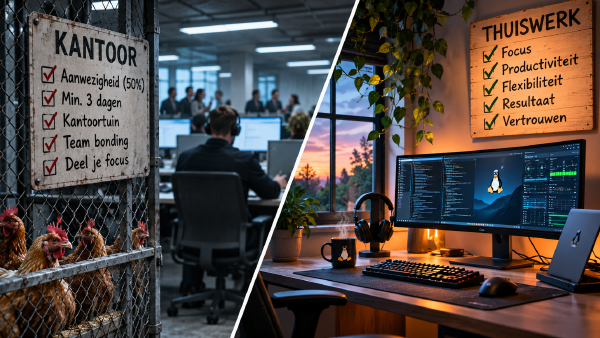

The Engineer Behind the Keyboard#
Feed the monkey and leave me the fuck alone.
I’ve been saying that for years. Feed the monkey and leave me the fuck alone. It probably sounds antisocial to people who don’t know me, but that’s not really how I am. I’m actually quite social, sometimes a bit too social. Put me in a room with a couple of engineers, some coffee and an interesting technical subject, and there’s a good chance we’ll still be talking an hour later. I enjoy working with people, especially engineers who know their stuff and aren’t afraid to have a proper discussion. At the same time, when I’m working on something complicated, I need to be able to concentrate. Give me a keyboard, a problem, the tools to solve it and some peace and quiet. That’s usually enough.
I’ve written about this before in Feed the Monkey: What Nobody Tells You About Context Switching. That article was mainly about interruptions, technical shorthand and what happens when an engineer has to constantly switch between solving a problem and explaining it. This time I want to explain a little more about the engineer behind that particular monkey, because there’s more to it than simply wanting to be left alone.
The Office Wasn’t Always the Problem#
Years ago, we had an office in Leusden, about 45 minutes from my home. I actually enjoyed going there. We already worked hybrid back then, and the office was a decent place to get some work done. We had separate rooms where I’d either sit with another engineer or work on my own. No open-plan office, no constant background noise and no managers wandering around checking whether everyone was being productive.
The social side was there too. We’d meet at the coffee machine, during lunch or outside for a cigarette, back when I still smoked. I’m quite a social guy, sometimes a little too social, so those conversations could easily take longer than planned. But afterwards you went back to your room, closed the door and got on with your work. I liked that balance.
Then the Leusden office closed. Same job, same infrastructure, same colleagues, but suddenly the nearest practical office was a lot further away. What used to be a 45-minute drive became two hours on a Tuesday and sometimes two and a half hours on a Thursday. One way. Four to five hours in a car to end up in an open-plan office where concentrating is difficult and managers seem to have an opinion about everything. Meanwhile, the servers are still somewhere else, so I end up opening my laptop and connecting to exactly the same systems over SSH that I could have accessed from home.
I still work for the same organisation, although quite a few things have changed around me. The work itself hasn’t suddenly become different. I still solve technical problems, build infrastructure and keep systems running. What changed was the environment in which I’m expected to do it. And I honestly struggle to see how spending four or five hours travelling makes any of that better.
I’ve covered the broader problem with mandatory office attendance in The RTO Charade: A Systemic Engineering Failure. I won’t repeat the entire argument here. The point is that I never had a problem with going to an office. I had a problem with losing a working environment that actually allowed me to concentrate, only to replace it with longer commutes and more distractions.
Twenty Minutes to KoloDC#
KoloDC, formerly Serverius, is about twenty minutes from my house. I regularly go there to work on my servers, and I genuinely enjoy it. I walk in, do whatever maintenance is needed, grab a coffee and find myself a flex desk where I can continue working. It’s a familiar environment where I know my way around and can just get on with things.
Selin works there, but I’ve known him since we were kids. He’s a friend from way before KoloDC or any of this IT stuff. Peter is another KoloDC customer I work with, and over the years we’ve got to know each other pretty well. Sometimes one of them drops by, we have a chat, exchange some ideas or just have a laugh, and then everybody goes back to whatever they were doing.
That’s something I really appreciate about the place. There’s no pressure to constantly interact with people, but there’s always someone around for a decent conversation. Most people there are technical, they understand what you’re doing and they generally respect it when you’re concentrating on something. And yes, sometimes I end up talking for far too long myself. I like the company, so I’m certainly not going to pretend that every interruption comes from somebody else.
I hear people complain about datacenter visits, but for me they’re one of the nicest parts of the job. I feel comfortable there. I’ve got my equipment nearby, good facilities, coffee within reach and people I enjoy spending time with. Nobody breathing down my neck and no need to justify why I’m sitting behind a terminal. I can just do my work, at my own pace, in an environment where I feel at home.
Feed the Monkey#
I’ve been working with Linux, infrastructure, networking, virtualization and security for more than twenty-five years. What I enjoy most hasn’t really changed. I like figuring out how things work, why they break and how to make them better. I’m happy designing a new environment, but I also want to build it, configure it and troubleshoot it when something doesn’t behave the way it should.
Recently I’ve been dealing with database cluster failures, building a replacement cluster, migrating a password management platform, investigating problems with a central logging server and following several critical security advisories. At the same time I’m working on security monitoring, vulnerability scanning, automation and technical documentation. It’s a lot of different work, often happening at the same time, but I genuinely enjoy it.
When a cluster fails, I want to know why. Getting it running again is only part of the job. I also want to understand what caused the failure and what needs to change to prevent it happening again. The same goes for security vulnerabilities. I want to understand the exposure, identify the affected systems, put appropriate measures in place and verify that the problem has been addressed.
That’s the kind of work that keeps me interested. I enjoy working with colleagues who approach problems in the same way. We discuss possibilities, test assumptions and sometimes disagree. That’s fine. I’d rather have someone challenge my ideas with a good technical argument than agree with everything I say.
For me, feed the monkey means giving an engineer a clear objective, the proper tools and enough room to do the job. It doesn’t mean avoiding responsibility or refusing to explain what I’ve done. I’ll document changes, discuss risks and stand behind my decisions. What I don’t need is someone constantly checking whether I’m doing things their preferred way. If there’s a problem with my approach, let’s discuss it. Otherwise, let me get on with it.
Experience Changes Your Perspective#
After more than twenty-five years in IT, I’ve learned that being busy and being productive aren’t necessarily the same thing. You can spend an entire day answering questions, attending meetings and switching between unrelated subjects without making much progress on the work you originally intended to do.
I’ve also learned that being the person who always solves the problem comes with its own complications. I wrote about this in I Always Get It Done (That’s the Problem). When people know you’ll figure something out, they tend to come back to you. Often with good reason, and I genuinely enjoy helping colleagues, but it can gradually turn into a situation where every difficult problem ends up on the same desk.
I’m not particularly good at ignoring an interesting problem either. When a database cluster starts behaving strangely, I want to understand what’s happening. When something breaks, I want to fix it properly rather than applying a quick workaround and walking away. That curiosity is probably one of the reasons I’ve stayed interested in technology for so long.
But there’s a difference between enjoying a challenge and making yourself available for every problem at any time. Experience has taught me to pay more attention to how I spend my time, which problems genuinely require my involvement and when it’s better to let someone else take ownership.
I still enjoy a difficult technical challenge as much as I did years ago. I just prefer spending my time actually solving it rather than explaining to five different people why I’m not finished yet.
Responsibility Without the Circus#
I don’t particularly care about having an impressive job title. I’ve met excellent engineers with ordinary titles and people with impressive ones who weren’t particularly good at solving technical problems. A title doesn’t tell me whether someone understands Linux, knows how to troubleshoot a database or can design a reliable infrastructure.
What matters to me is being able to do the work properly. I like having responsibility and being trusted to make technical decisions. I don’t mind explaining those decisions or being challenged on them. In fact, I prefer working with people who are willing to tell me when they think I’m wrong.
What frustrates me is when organisations spend more time discussing job classifications, office attendance and internal procedures than understanding the work people actually do. Especially when the same engineers are still expected to solve the difficult problems whenever something goes wrong.
I don’t want to become a manager, and I don’t want to spend my days in meetings talking about work that could have been done in the meantime. I enjoy architecture, but I also want to keep working with the actual systems. Give me the opportunity to design something and then let me build it. That’s where I get the most satisfaction.
There’s nothing wrong with management or procedures when they serve a purpose. Good management provides direction, removes obstacles and makes sure people have what they need. Procedures can prevent mistakes and make work reproducible. I use them myself. What I struggle with is unnecessary interference that makes a fairly straightforward technical job more complicated than it needs to be.
Let Me Do My Job#
I work best in a quiet environment where I can concentrate and where people trust me to take responsibility for what I’m doing. Sometimes that’s at home, sometimes at KoloDC and sometimes in an office with the right people. I don’t mind travelling when there’s a good reason for it. Physical maintenance, working directly with other engineers or solving a problem together are perfectly good reasons.
Driving four or five hours to sit in a noisy office and connect to remote servers isn’t one of them.
I enjoy being around colleagues. I enjoy a good technical discussion and I can easily spend too much time talking myself. But I also need uninterrupted time to concentrate, and I want to be able to decide when that time is necessary.
After all these years I still enjoy the same things that got me interested in IT in the first place. A difficult problem, a terminal, a few good engineers to exchange ideas with and the satisfaction of getting something working properly. I don’t need an open-plan office, constant supervision or a management meeting to make that happen.
Give me a problem, the tools, the responsibility and a place where I can concentrate.
Feed the monkey and leave me the fuck alone.