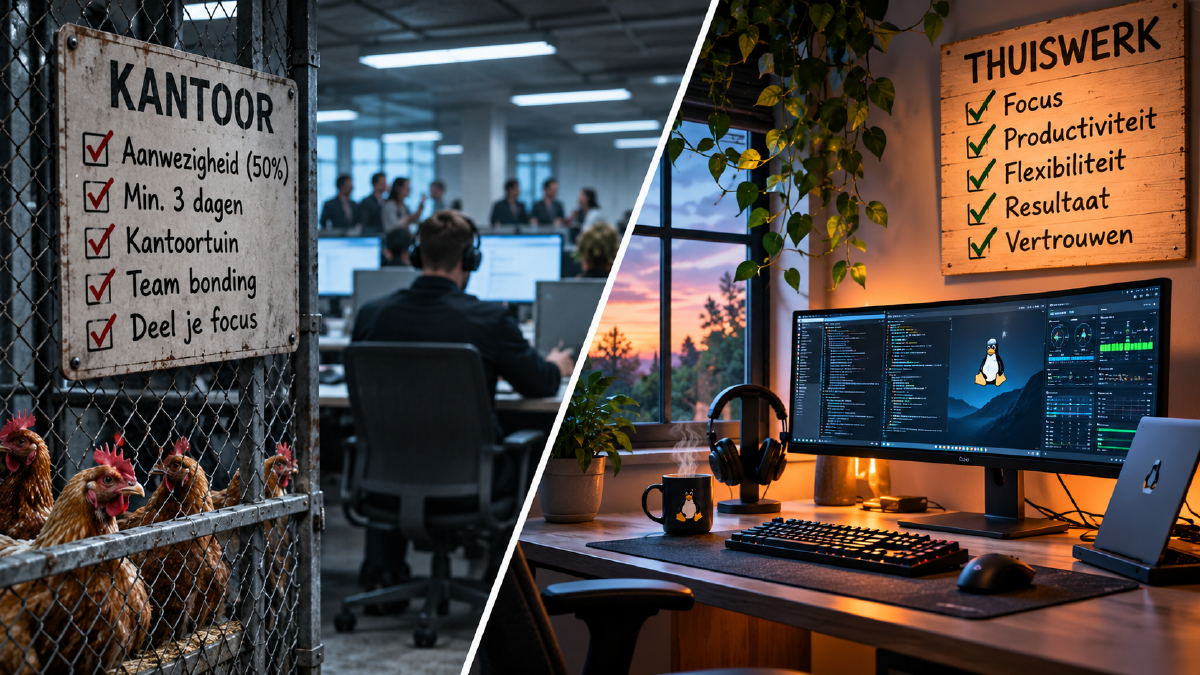

A recent LinkedIn post by Joey Blaauw started an interesting discussion about working from home. Apparently, some employers are still worried that employees might put a load of laundry in the washing machine during working hours. Reading through the comments, I was surprised by how many people still seem to believe that being physically present in an office is somehow proof that you’re actually working.
I’ve been working from home for years. As a platform engineer, I manage Linux servers, infrastructure, security and automation. Most of those systems are located in data centres, not in an office building. Whether I connect to them from home or from a corporate office makes very little technical difference. SSH doesn’t suddenly work better because I’m sitting next to a coffee machine, and Ansible doesn’t care whether I’m wearing slippers or office shoes. What does make a difference is whether I can concentrate on what I’m doing.
Productivity Doesn’t Follow Office Hours#
Over the years, I’ve regularly configured servers in the evenings or during weekends. Not because someone told me to, but because those were the moments when I had the concentration to do it properly. No interruptions, no colleagues walking up with questions, no background conversations and no meetings interrupting my train of thought. Sometimes an idea for a configuration change or infrastructure improvement comes to mind at ten in the evening. When that happens, I might sit down and work on it. Other times, I might spend part of an evening doing absolutely nothing. That’s fine too. My work gets done, my responsibilities are taken seriously and the infrastructure keeps running.
That’s something I find increasingly difficult to reconcile with traditional corporate thinking. We expect experienced IT professionals to take responsibility for complex environments, make independent decisions and occasionally deal with problems outside normal office hours. Yet some organisations still insist on measuring their commitment through physical attendance. Apparently, being trusted to maintain critical infrastructure doesn’t automatically mean you’re trusted to decide where you can work most effectively.
For me, concentration isn’t a luxury. When you’re troubleshooting a complicated problem, writing automation or working on security configurations, interruptions are expensive. It takes time to get back into a problem after someone has interrupted you, particularly when you’re working through something that requires keeping several technical details in your head at once. That’s why I often get more meaningful work done during a few uninterrupted hours at home than during an entire day in a busy office.
The Corporate Chicken Coop#
One of the most popular arguments for returning to the office is social interaction. Team bonding, spontaneous conversations, exchanging ideas at the coffee machine and all the other things that apparently make an office such a wonderful place to work. I’m sure some people genuinely enjoy that environment, and they’re welcome to it. Personally, I wasn’t hired to attend a social gathering. I was hired to manage infrastructure and solve technical problems.
Modern open-plan offices are particularly fascinating in this respect. We put dozens of people together in one large room, surround them with phone calls, conversations and constant movement, and then wonder why everyone is wearing noise-cancelling headphones. People travel to the office because collaboration is supposedly important, only to spend most of the day trying to isolate themselves from everyone around them. A chicken coop with laptops, except the chickens probably get interrupted less often.
Of course, there are situations where meeting colleagues in person makes sense. Technical workshops, specific project discussions or activities that genuinely benefit from being in the same room can be useful. But that’s different from requiring people to attend an office simply because a policy says they should. If there’s a reason to meet, arrange a meeting. If the work requires concentration, let people work somewhere they can actually concentrate. Someone else’s preference for social interaction shouldn’t automatically become my obligation to be distracted.
The Office That Moved Away#
During COVID, our office was closed. Like many organisations, we adapted to working remotely and continued doing our jobs. Servers were maintained, incidents were resolved and infrastructure projects continued. Remote working wasn’t some temporary experiment that collapsed as soon as management stopped watching. It became an established way of working, and for me it worked extremely well.
The replacement office is now more than two hours of travel away from my home. That’s quite a journey just to sit behind another computer and connect to the same servers I can already manage from home. The infrastructure hasn’t moved into that building, my responsibilities haven’t changed and the technical requirements of my job are exactly the same. The only real difference is that I would spend a considerable amount of time travelling before I could start doing the work.
There’s something deeply ironic about this in IT. We’ve spent decades developing remote access, automation, virtualisation, distributed infrastructure and management platforms specifically to make physical location less relevant. I can manage systems across multiple data centres, troubleshoot problems remotely and automate entire environments without being anywhere near the hardware. Yet somehow, the person operating those systems is expected to travel for hours to sit in a particular building. We’ve made the infrastructure location-independent, only to make the people managing it location-dependent again.
When Harmonisation Becomes a Step Backwards#
This discussion has become particularly relevant to me because I’m currently dealing with a corporate harmonisation of employment conditions. The new employee handbook introduces a maximum of two working days from home per week, combined with a requirement for at least 50% office attendance. For someone who has worked remotely for years, especially after the original office was closed, that’s not a minor adjustment. It’s a fundamental change in how I’m expected to organise my working life.
What makes it difficult to accept is that nothing about my actual job has changed. I’m still managing the same kind of infrastructure, solving technical problems and taking responsibility for systems that need to remain available. There hasn’t suddenly been a technical development that requires me to sit in an office several days a week. The change comes from a corporate policy, not from the requirements of the work.
I understand why large organisations want to harmonise employment conditions. Having one set of rules is administratively convenient, easier to communicate and probably looks excellent in a management presentation. But consistency isn’t automatically an improvement. When an organisation replaces arrangements that have worked successfully for years with a more restrictive policy, it should at least be able to explain what problem it’s trying to solve. Has productivity declined? Have service levels deteriorated? Is there evidence that mandatory attendance will improve the quality of our work? Or is it simply easier to make everyone follow the same rules?
For me, this is about more than the number of days I’m allowed to work from home. It’s about professional autonomy and the trust that has existed for years. Being responsible enough to manage complex infrastructure independently, but apparently not responsible enough to choose an effective working environment, is a rather strange contradiction.
Flexibility Works Both Ways, Doesn’t It?#
Another part of this discussion that rarely receives enough attention is how much flexibility employees already provide to their employers. I’ve regularly worked on servers outside normal business hours, sometimes because maintenance was better performed when systems were less busy, but often simply because I had the focus or an idea I wanted to work on. When something needs attention in the evening or during a weekend, nobody asks whether I’m sitting in the correct office building. What matters is that the problem gets solved.
But when that same employee wants to work from home during normal business hours, suddenly flexibility becomes a problem that requires policies, restrictions and attendance percentages. When the employer benefits from flexibility, it’s called commitment. When the employee benefits from it, it becomes something that needs to be managed. That’s an odd way to build a relationship based on mutual trust.
This doesn’t mean people should be expected to work every evening or weekend. Quite the opposite. It means that professionals should have reasonable freedom to organise their work, with clear agreements about responsibilities, availability and results. I don’t mind being held accountable for my work. I do mind being treated as though sitting in a particular building is somehow a substitute for that accountability.
The Washing Machine Argument#
And then there’s the washing machine. The apparently terrifying possibility that someone working from home might spend five minutes doing something unrelated to work. It’s remarkable how often this argument appears, particularly when nobody seems equally concerned about the time spent at office coffee machines, smoking areas or in conversations that have absolutely nothing to do with work.
Of course, some people misuse the freedom to work remotely. Some people also waste enormous amounts of time at the office. Neither situation is particularly surprising, and neither justifies treating everyone as though they can’t be trusted. If someone consistently fails to deliver, address their performance. That’s what management is supposed to do. Making an entire workforce commute because a few employees might take advantage of remote working isn’t management; it’s avoiding the responsibility of dealing with individual performance.
I also find the argument that other professions cannot work from home rather strange. Of course a nurse needs to be physically present to care for patients, and a mechanic can’t repair a vehicle through an SSH connection. Different jobs have different requirements. That doesn’t mean a platform engineer should spend hours travelling to manage servers remotely simply because someone else has a job that requires physical presence.
You Can Mandate Attendance, Not Commitment#
An employer may be able to introduce mandatory office attendance, depending on employment agreements and applicable law. But the ability to introduce a policy doesn’t automatically make it a sensible policy. Particularly in IT, where experienced professionals have options and working conditions are an important part of choosing an employer.
If an organisation removes flexibility that employees have relied on for years, it shouldn’t be surprised when some of them start looking elsewhere. People don’t necessarily leave because they dislike their work. Sometimes they leave because the organisation changes the conditions under which they were happy doing that work. You can make office attendance mandatory, but you can’t make people appreciate the change simply because HR has written it into a handbook.
I don’t need an office full of people to prove that I’m working. I need the freedom to concentrate, the tools to do my job and the trust to take responsibility for the results. I’ve worked that way for years, and I see no reason why a corporate harmonisation should suddenly make it less effective.
We built an entire digital world around remote access and location-independent infrastructure. Perhaps it’s time management caught up with the technology.
I make my contribution through the work I deliver, not through the hours I spend occupying an office chair.